We are soliciting suggestions and seeking volunteers for our Society’s Funding and Career Development chair. Our DMDU Society is governed by an eight-member, volunteer leadership team elected by its membership. The leadership team’s Funding and Career Development position is currently vacant. According to our Rules and Processes, the leadership team…
New Zealand guidance on Coastal Hazards and Climate Change has now DMDU methods as its core
On 15 December the New Zealand Government issued revised national Guidance on Coastal Hazards and Climate Change for decision makers which has DMDU methods at its core. Dynamic Adaptive Pathways Planning is used to address uncertainties around hazards and sea-level rise beyond mid-century when the uncertainty bands widen. The framework of…
Rival Framings: A Framework for Discovering How Problem Formulation Uncertainties Shape Risk Management Tradeoffs in Water Resources Systems
Quinn, J., Reed, P.M., Giuliani, M., and Castelletti, A., “Rival Framings: A Framework for Discovering How Problem Formulation Uncertainties Shape Risk Management Tradeoffs in Water Resources Systems.”, Water Resources Research, v53, DOI: 10.1002/2017WR020524, 2017. http://onlinelibrary.wiley.com/doi/10.1002/2017WR020524/full Managing water resources systems requires coordinated operation of system infrastructure to mitigate the impacts of…
Getting to grips with uncertainty across multiple scales at the 5th Annual Workshop on Decision Making under Deep Uncertainty
Today’s decision makers face conditions of fast-paced, transformative, and often surprising change. Decisions on issues such as climate change mitigation and adaptation, defense spending or avoiding the collapse of financial systems are all plagued by diverse and complex uncertainties. So how do we respond to this world of increasing uncertainty?…
UNFCCC COP23 Side Event: ‘Making robust investment decisions under deep uncertainty’
Title Making robust investment decisions under deep uncertainty: a new approach to sustainable development planning in uncertain world Date and time November 8th, 2017 10:30-12:00 @Japan Pavilion (COP23 Bonn Zone) * To attend the event, it is necessary to register for COP23 to enter Bonn Zone. For information on the…
Managing deep uncertainty: Exploratory modeling, adaptive plans and joint sense making
Reposted from https://i2insights.org/2017/08/15/managing-deep-uncertainty/ How can decision making on complex systems come to grips with irreducible, or deep, uncertainty? Such uncertainty has three sources: Intrinsic limits to predictability in complex systems. A variety of stakeholders with different perspectives on what the system is and what problem needs to be solved. Complex systems…
Scenario techniques for energy and environmental research: An overview of recent developments to broaden the capacity to deal with complexity and uncertainty (2017)
Scenario techniques are a teeming field in energy and environmental research and decision making. This Thematic Issue (TI) highlights quantitative (computational) methods that improve the development and use of scenarios for dealing with the dual challenge of complexity and (deep) uncertainty. The TI gathers 13 articles that describe methodological innovations…
2017 Membership Survey

You will find below our 2017 membership survey. Please, answer these questions, as your answers will help us to shape our next actions. The survey will be opened for answers until Oct 20th. Click on this link to answer the survey on a separate page.
Adaptation pathways in planning for uncertain climate change: Applications in Portugal, the Czech Republic and the Netherlands 2017
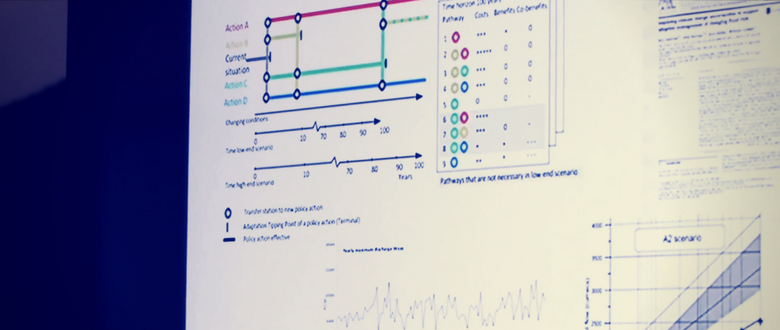
Mark Zandvoort, Inês S. Campos, André Vizinho, Gil Penha-Lopes, Eliška Krkoška Lorencová, Rutger van der Brugge, Maarten J. van der Vlist, Adri van den Brink, Ad B.M. Jeuken, Adaptation pathways in planning for uncertain climate change: Applications in Portugal, the Czech Republic and the Netherlands, Environmental Science & Policy, Volume…
Applying Principles of Uncertainty within Coastal Hazard Assessments to Better Support Coastal Adaptation (2017)

Stephens, S.A.; Bell, R.G.: Lawrence, J. (2017). Applying principles of uncertainty within coastal hazard assessments to better support coastal adaptation. Journal of Marine Science and Engineering 5(3): 40; doi:10.3390/jmse5030040 http://www.mdpi.com/2077-1312/5/3/40 Abstract: Coastal hazards result from erosion of the shore, or flooding of low-elevation land when storm surges combine with high…